 how-to
Positive Handling Training Explained
Table of Contents
- What Positive Handling Training Actually Involves (and Why It Matters in UK Workplaces)
- Who Should Have Positive Handling Training? Sector-by-Sector Breakdown
- De-Escalation Techniques for Staff: What You'll Practise on the Day
- Physical Intervention Training: What's Covered and What Isn't
- Positive Handling Training Certification: How It Works and How Long It Lasts
- Choosing Conflict Management Training That Sticks (and Passes Scrutiny)
- Common Mistakes When Organisations Buy Positive Handling Training
- Frequently Asked Questions
Last Updated: 7 October 2026
What Positive Handling Training Actually Involves (and Why It Matters in UK Workplaces)
Positive Handling training is a structured conflict management programme that teaches staff how to prevent, defuse and safely respond to aggressive behaviour at work. We deliver this as practical, easy-to-recall training built for high-pressure settings.
The name comes from “Positively Handling” situations to obtain the safest outcome for all involved. Most UK providers now deliver their own version, aligned to the same core principles.
So what does a typical course cover?
- Prevention: spotting triggers before behaviour escalates
- De-escalation: verbal and non-verbal techniques to calm a situation
- Physical intervention: safe, last-resort holds and escorts
- Post-incident support: debriefing and reporting
The Health and Safety Executive's guidance on work-related violence is clear that employers have a legal duty to protect staff from foreseeable harm. That duty is what makes positive handling training more than a box-ticking exercise.
Who Should Have Positive Handling Training? Sector-by-Sector Breakdown
Any role where staff face aggression, distress or unpredictable behaviour benefits from positive handling training. That covers far more than security teams.
Here's how it breaks down by sector:
Sector | Typical Roles | Main Risk |
|---|---|---|
Healthcare | Nurses, porters, A&E staff | Patient aggression, distress |
Education | Teachers, SEND staff, bursars | Pupil dysregulation, distress |
Social care | Carers, support workers | Challenging behaviour, complex needs |
Public transport | Revenue staff, drivers | Fare evasion, lone working |
Retail and hospitality | Front-of-house, security, BID Teams | Theft response, intoxication, Anti-Social Behaviour |
Security | Officers, supervisors | Physical confrontation |
A common mistake is booking the same off-the-shelf course for a secure unit and a busy BID team. The risks are different, so the training should be too.
De-Escalation Techniques for Staff: What You'll Practise on the Day
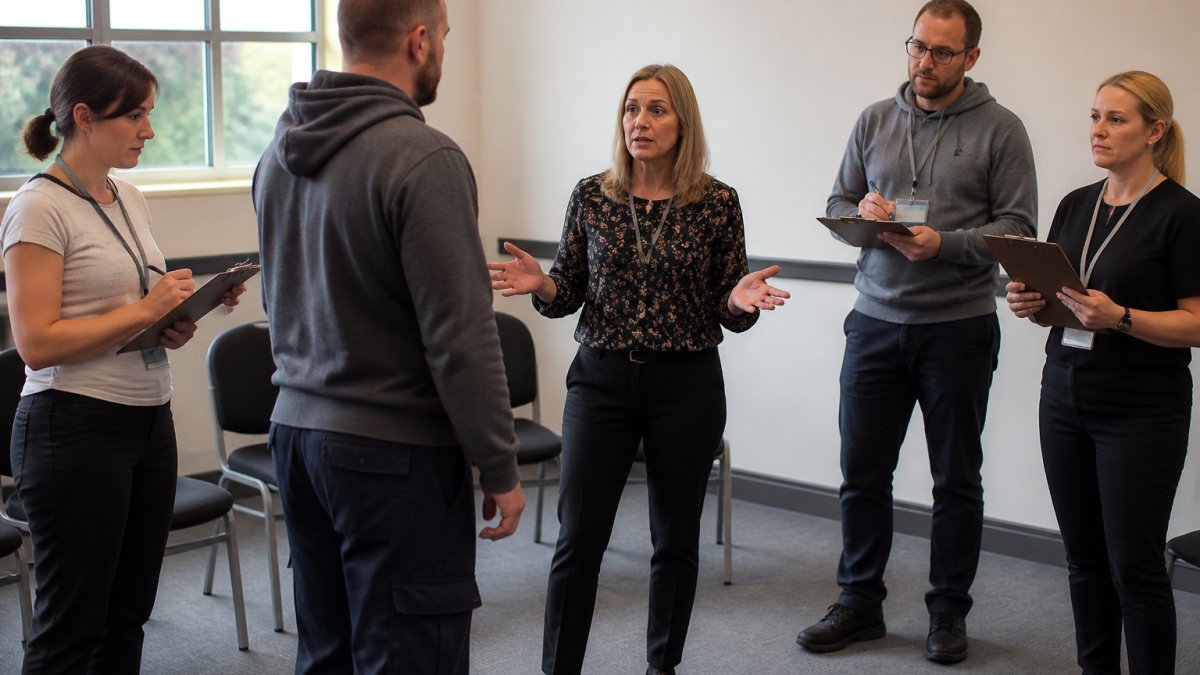
De-escalation techniques for staff are the verbal and non-verbal skills used to reduce tension before a situation turns physical. On a good course, you practise these in realistic scenarios, not just watch slides.
Verbal De-Escalation: What to Say and What to Avoid
Verbal de-escalation is about lowering the temperature through tone, pacing and choice of words. Small changes in phrasing make a big difference.
What works:
- Speak slowly and quietly
- Use the person's name
- Offer simple choices
- Acknowledge their frustration
What to avoid:
- Raising your voice to match theirs
- Saying "calm down"
- Standing over the person
- Making promises you can't keep
Reading Early Warning Signs Before a Situation Escalates
Most incidents give warning signs before they peak. Learning to read them buys you time to act early.
Watch for:
- Clenched fists or jaw
- Pacing or restlessness
- Raised voice or swearing
- Fixed staring
- Sudden silence
Physical Intervention Training: What's Covered and What Isn't
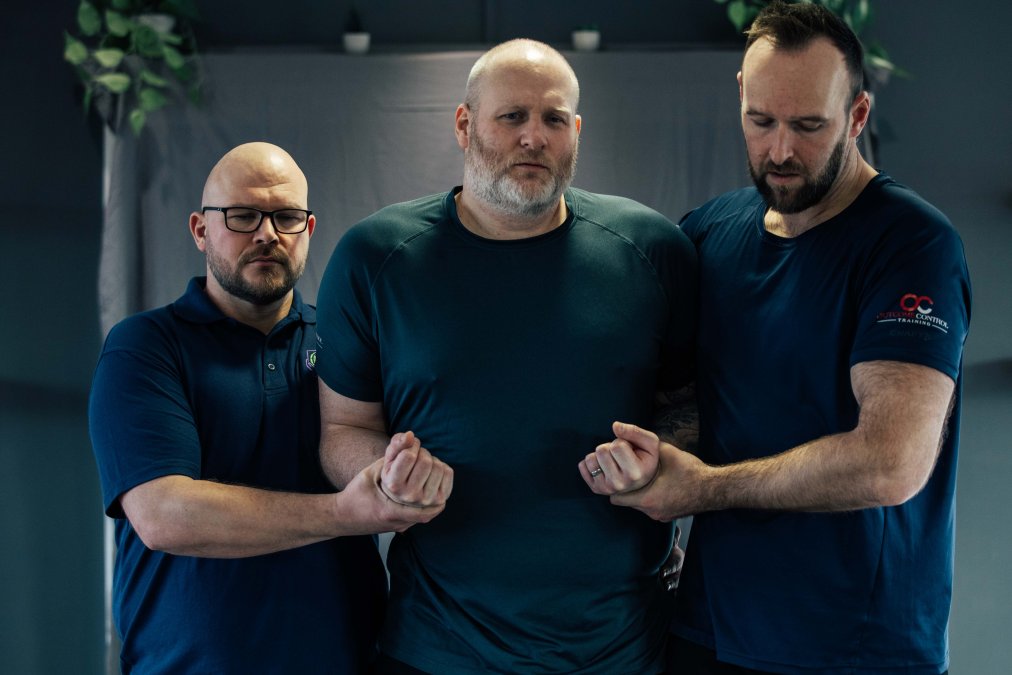
Physical intervention training covers the safe, last-resort techniques used when de-escalation alone isn't enough. It focuses on reducing risk, not winning a struggle.
Typical content includes:
- Safe holding and escorting
- Breakaway techniques
- Positioning and posture
- Team approaches
- When to stop
What it should avoid pain compliance or techniques that rely on excessive force. Our programmes are medically reviewed and risk-assessed, and we keep holds simple so staff can recall them under pressure.
Book a FREE 30-minute Consultation →
The goal is always the shortest, safest intervention possible. That protects both the person in crisis and the staff member.
Positive Handling Training Certification: How It Works and How Long It Lasts
Positive Handling training certification confirms that a staff member has completed an approved course and can apply its techniques safely. Most certifications last 12 months, though this varies by provider and sector.
Key points to know:
- Certification is usually valid for one year
- Refreshers are required to stay current
- Records should be kept for compliance
- Some roles need annual reassessment
The Institute of Conflict Management's guidance on training standards is a useful reference for what good certification looks like.
Choosing Conflict Management Training That Sticks (and Passes Scrutiny)
Conflict management training only works if staff can recall it when things kick off. That means simple techniques, realistic practice and content matched to your setting.
A recent NHS England review of violence reduction highlighted that staff confidence and retention improve when training is relevant and ongoing, not a one-off event.
Questions to Ask Any Provider Before You Book
- Is the training risk-assessed for our specific environment?
- Are techniques medically reviewed?
- How long is certification valid, and what does renewal involve?
- Can you tailor scenarios to our sector?
- What post-incident support do you offer?
If a provider can't answer these clearly, keep looking.
Common Mistakes When Organisations Buy Positive Handling Training
The biggest mistake is treating training as a tick-box purchase. It shows up in three ways.
Buying generic content for a specialist setting. A secure unit and a retail floor need different scenarios. Generic training doesn't translate.
Skipping refreshers. Skills fade fast. Annual renewal isn't optional if you want staff to act confidently.
Ignoring the reporting loop. Training without better incident reporting and feedback means lessons never get learned. Staff get frustrated and disengage.
Frequently Asked Questions
What is Positive Handling training and what does it teach?
Positive Handling training is a structured programme that teaches staff how to prevent, de-escalate and safely manage challenging behaviour. It covers verbal de-escalation techniques for staff, recognising early warning signs, understanding the crisis cycle, and, where legally and ethically appropriate, physical intervention training for last-resort situations. The focus is on keeping everyone safe, reducing the duration of any restraint, and giving staff simple techniques they can recall under pressure.
How long does Positive Handling training certification last and does it need refreshing?
Most Positive Handling training certification runs for a set period, typically a year depending on the provider and the level of course. Refreshers matter because skills fade without practice, and regulators expect evidence of ongoing competence. Many UK organisations build annual refreshers into their training plan, with shorter de-escalation top-ups in between. Check the certification expiry date and book the refresher before it lapses.
Is Positive Handling training available online, and does it include physical intervention?
Theory elements, such as understanding behaviour and de-escalation techniques for staff, can often be delivered online or as blended learning. Physical intervention training, however, needs to be taught face-to-face so staff can practise techniques safely and receive feedback. Most credible providers split the course this way: online modules for knowledge, in-person sessions for practical skills. Ask any provider how they structure this before booking.
How can an organisation choose suitable conflict management training?
Start by mapping the real incidents your staff face, then ask providers how they tailor content to your sector and environment. Look for medically reviewed techniques, risk-assessed physical interventions, and trainers affiliated with recognised bodies such as the Institute of Conflict Management. Request case studies from similar organisations and check refresher options.
Staff who feel unsupported in the face of aggression burn out, and that costs you far more than any course. Personal Safety Partnership Ltd. has spent over 10 years helping NHS trusts, schools, care homes and transport operators build training that actually sticks. Our programmes are medically reviewed, risk-assessed and tailored to your setting, with techniques staff can recall under pressure. Book a free 30-minute consultation and find out what bespoke cpi training could do for your team.